
How Mentorship Boosts Data Career Growth
Mentorship is one of the fastest ways to grow your career in data roles like engineering, analytics, and AI. Why? Because it bridges the gap between what schools teach and the challenges of real-world data work. Here’s what mentorship can do for you:
- Learn Faster: Get hands-on guidance with tools like Databricks and AWS, saving time on trial-and-error.
- Advance Your Career: Mentees are 5x more likely to get promoted and 90% report higher job satisfaction.
- Expand Your Network: Mentors connect you to opportunities, projects, and key decision-makers.
The numbers don’t lie: companies with mentorship programs see 30% better retention in technical roles, and mentees report a 50% boost in industry contacts. Whether it’s solving technical problems, improving communication, or finding new opportunities, mentorship can make all the difference.
If you’re ready to grow, start by reaching out to potential mentors in your network or joining structured programs like DataExpert.io Academy’s boot camps. The right mentor can help you navigate challenges and set you up for long-term success.
Guiding data minds: how mentoring transforms careers for both sides
sbb-itb-61a6e59
How Mentorship Benefits Data Professionals
Mentorship accelerates skill development, career growth, and networking opportunities, creating a ripple effect that benefits data professionals at every stage of their journey.
Learning Technical Skills Faster
Navigating complex tools like Databricks, Snowflake, or AWS can feel overwhelming, especially when you're on your own. Mentors simplify the process by offering tailored guidance, saving you from endless hours of trial and error.
"My team is fairly new to the Databricks Platform and Spark, so we looked into the data engineering bootcamps to speed up onboarding and improve the reliability of our build processes." - Nick Ambrose, Director of Engineering at Outreach
The numbers tell a compelling story: pairing a novice with an experienced mentor boosts project success rates by 37%. That’s because mentors bring something textbooks and tutorials can’t - real-world problem-solving. They teach you how to debug tricky data pipelines, fine-tune queries for production, and deploy models using tools like Docker or Kubernetes. And since 70% of workplace learning happens through hands-on experience, mentorship becomes a far more effective method than passive study.
"In addition to technical learning, we've talked about the industry, companies, jobs, and salaries... His mentorship has opened my eyes to what it takes to be a successful DevOps engineer." - Marwan Wasel, DevOps Engineer at MoovingON
This kind of targeted, practical learning not only builds technical expertise but also lays the foundation for climbing the career ladder.
Moving Up the Career Ladder Faster
Mentorship has a profound impact on career advancement. Consider this: 75% of executives attribute their success to having a mentor, and 90% of employees with mentors report higher job satisfaction. But it’s not just about feeling good - mentorship delivers measurable results. Research shows that mentees of top-tier mentors are 5.4 times more likely to reach senior roles.
One reason for this is the "soft" skills mentors help develop. From prioritizing key tasks to effectively communicating results to leadership, these are the skills that separate senior professionals from their junior counterparts - yet they’re rarely covered in formal training programs. Companies recognize this too: those with mentorship programs see a 30% increase in retention rates for technical roles.
But mentorship doesn’t stop at skill-building or promotions; it also expands your professional network.
Building Professional Networks
Mentors often provide access to opportunities you might not find on your own. They introduce you to hiring managers, recommend you for key projects, and even advocate for your ideas in meetings you’re not part of. The results are tangible: mentees typically report a 50% increase in industry contacts thanks to mentorship.
This kind of advocacy is especially impactful for underrepresented groups. For example, women in STEM with sponsors are 200% more likely to have their ideas implemented at work compared to those without support.
"My mentor gave me great tips on how to make my resume and portfolio better and he had great job recommendations during my career change." - Samantha Miller, Data Analyst
These connections often lead to opportunities that go beyond what public job boards can offer. When combined with technical and career insights, mentorship becomes a bridge between theory and real-world success. For those just starting out, following a structured data engineering roadmap can help identify where a mentor's guidance is most needed.
What Research Shows About Mentorship
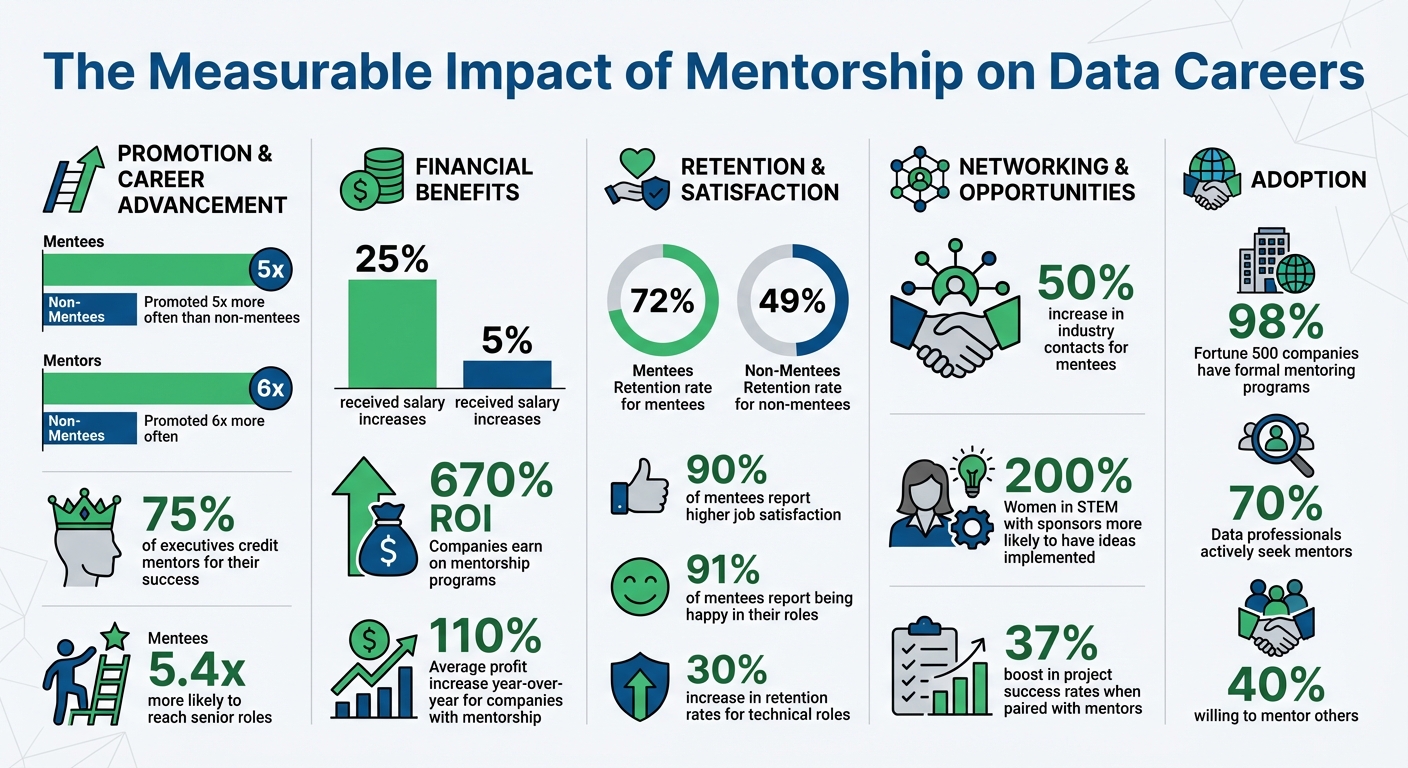
Mentorship Impact on Data Career Growth: Key Statistics and Outcomes
Numbers That Show Mentorship Works
A long-term study conducted at Sun Microsystems followed 1,000 employees and revealed some striking results: mentees were promoted five times more often than employees without mentors. Interestingly, mentors also benefited, being six times more likely to receive promotions themselves. This shows that mentorship is a two-way street with rewards for both parties.
The financial perks of mentorship are just as compelling. 25% of mentees saw salary increases, compared to only 5% of employees who weren’t part of mentoring programs. Retention rates also tell a powerful story - mentees stayed with their companies 72% of the time, while non-participants had a retention rate of just 49%. For businesses, the return on investment is massive: companies report earning an average of 670% for every dollar spent on mentoring, thanks to reduced turnover and lower recruitment costs.
| Metric | Mentees | Non-Mentees |
|---|---|---|
| Promotion Rate | 5x higher | Baseline |
| Salary Increase | 25% | 5% |
| Retention Rate | 72% | 49% |
| Job Satisfaction | 91% report being happy | Lower/Baseline |
In specialized fields like physics, biomedicine, and mathematics, mentorship plays an even bigger role. Studies show that it can lead to a 2x-to-4x increase in a protégé’s chances of receiving major scientific awards or being inducted into prestigious academies. For those aiming to excel in competitive industries, mentorship isn’t just helpful - it’s essential.
These numbers highlight why mentorship has become a cornerstone for both personal and organizational success.
Academic Research on Mentorship Models
Decades of research have explored what makes mentorship effective. One of the most influential frameworks comes from Kram’s work, which breaks mentorship into two main categories: Career functions and Psychosocial functions. Career functions include coaching, sponsorship, and providing access to valuable networks, while psychosocial functions focus on emotional support, confidence-building, and role modeling. Together, these functions create a holistic approach to professional and personal development.
"Mentorship is arguably a scientist's most significant collaborative relationship; yet of all collaborations, comparatively little research exists on the link between mentorship and protégé success." - PNAS
Another key insight from research is the importance of intellectual independence. The most successful mentees don’t just follow in their mentors’ footsteps - they eventually branch out into their own areas of expertise. A study in PNAS found that protégés of high-achieving mentors were 5.4 times more likely to reach senior positions - but only if they pursued independent research topics.
Modern mentorship programs are also evolving. For example, Stanford University ran a "near-peer mentoring" program from 2022 to 2025, pairing graduate students with undergraduates from non-R1 schools. These weekly remote meetings helped graduate mentors improve their skills in inclusive mentorship and project management, while undergraduates gained valuable research experience. Similarly, the Data Science for Social Good (DSSG) program applies this model, with graduate mentors guiding undergraduates through data projects and offering real-time feedback.
These programs excel at transferring tacit knowledge - the unwritten skills and strategies, like how to frame research problems or communicate complex ideas, that textbooks simply can’t teach. This blend of theory and practice explains why 98% of Fortune 500 companies now include formal mentoring programs in their operations.
Case Studies: Mentorship in Action
These examples highlight how focused mentorship can speed up career growth in data-related fields.
Moving from Junior to Senior Positions
Susanne Brockmann brought two decades of project management expertise into the tech world. In 2021, she joined Omdena's career mentoring program, where a lead machine learning engineer helped her merge her management skills with her budding data science knowledge. This combination proved powerful. Within months, she landed a Program Manager role in R&D at a semiconductor automation company.
"A career change is never a straight path and it is vital that you sell your actual skills and not what you would like to do. Find the connecting points between your previous jobs, your newly gained skills and the new position." - Susanne Brockmann, Program Manager
Her journey shows how mentorship can turn diverse experience into a clear path forward.
At Databricks, mentorship played a key role in helping interns Zach and Melanie transition into full-time Software Engineer roles. Through design reviews, whiteboarding sessions, and detailed feedback on pull requests, both quickly gained the skills needed to lead. Zach worked on performance benchmarks for Delta Lake's MERGE command, which became essential for company-wide decisions, while Melanie integrated third-party services for customer onboarding and took charge of frontend and UI projects.
"The best piece of advice I've been given is to go where you think you will learn the most and be challenged the most – surround yourself with people you admire or look up to; learn from them, and growth will naturally follow." - Melanie, Software Engineer, Databricks
How DataExpert.io Academy Uses Mentorship
Mentorship is also the backbone of DataExpert.io Academy's programs. Their 15-week 2026 Data and AI Engineering Challenge ($7,497) features dedicated mentor guidance, 15 guest speakers, and hands-on capstone projects. Participants receive personalized advice on advanced architectures, system optimization, and career planning, whether they're aiming for Senior, Staff, or Principal roles. Along the way, they gain practical experience with tools like Databricks, Snowflake, and AWS.
For shorter programs, the academy offers options like the Winter 2026 Analytics Engineering Camp, Data Engineering Boot Camp, and Spring 2026 AI Engineering Boot Camp (each priced at $3,000). These five-week intensives also include mentor support, with regular check-ins and project reviews. This structured model echoes the successful approaches seen at Databricks and Omdena, helping participants not only sharpen technical skills but also develop a leadership-focused mindset for advancing their careers quickly.
Summary and Next Steps
Research highlights how mentorship can accelerate career growth in the data field. Nearly 70% of data professionals actively seek mentors, while 40% are willing to mentor others. Yet, over half report challenges in finding one. In specialized areas, having a mentor can make data practitioners 2 to 4 times more likely to achieve top-tier success.
Beyond technical skills, mentorship offers problem-solving insights that go beyond textbooks. A good mentor not only sharpens your technical abilities but also helps you develop business literacy - translating complex models into actionable insights for non-technical stakeholders. The greatest impact comes when mentees apply their mentor's guidance to their own innovative projects, rather than simply mimicking their mentor's methods.
If you're considering mentorship, you don’t need to wait for a formal program at work. Take the initiative by exploring professional associations, networking groups, or specialized academies. For instance, DataExpert.io Academy offers structured mentorship, including weekly Q&A sessions with founder Zach Wilson, access to guest speakers from companies like OpenAI and Meta, and both long-term programs and shorter boot camps tailored for career advancement at all levels.
Whether you're tackling technical roadblocks or planning your next career steps, mentorship can provide the clarity and confidence to move forward. Start by setting clear goals, preparing thoughtful questions, and making your meetings with mentors as productive as possible.
Mentorship isn’t just about personal growth - it’s shaping the leaders of tomorrow. With 92% of Fortune 500 companies now offering mentoring programs, the results speak for themselves: these initiatives contribute to an average 110% increase in profits year-over-year. Take action this week by identifying a potential mentor and reaching out.
FAQs
How do I find a mentor to grow my data career?
Connecting with a mentor in the data field can fast-track your career progress. A good place to start is by joining professional communities, forums, or networking platforms like LinkedIn. These spaces are often buzzing with experienced data professionals sharing insights and connecting with others. Jumping into discussions or attending virtual meetups can be a great way to spot potential mentors.
Industry events, conferences, and groups like Women in Big Data also offer excellent opportunities to meet seasoned experts. Before reaching out, take some time to define your career goals and pinpoint the areas where you’d like guidance. This clarity will help you approach the right person - someone whose expertise aligns with your aspirations. Once you’ve made a connection, focus on nurturing the relationship by staying in regular contact, setting clear expectations, and demonstrating your commitment to learning and growth.
For a more structured approach, consider mentorship programs like those from DataExpert.io Academy. These programs connect you with industry professionals, offer career development resources, and provide a supportive community to help you reach your goals.
What skills can a mentor help me grow as a data professional?
A mentor can guide you in building a diverse set of skills essential for thriving in data-related roles. This includes honing technical skills like data analysis, database management, and proficiency in tools such as SQL, Python, and cloud platforms. These abilities are key for tackling complex problems and staying relevant in a competitive industry.
But it doesn’t stop there. Mentors also help you sharpen soft skills - the kind that make you a strong communicator, an effective leader, and a strategic thinker. These are critical for working well with teams, presenting data insights clearly, and driving impactful decisions based on data. With their support, you can better manage responsibilities, break down complicated concepts, and handle workplace dynamics with confidence.
By focusing on both technical know-how and interpersonal growth, mentorship helps data professionals climb the career ladder and prepare for leadership opportunities in the field.
How can mentorship help me grow my career in data?
Mentorship can make a big difference in growing your career in data, offering tailored guidance, skill development, and insights into the industry. Research indicates that professionals involved in mentorship often learn faster, build confidence in their abilities, and are better prepared to step into leadership roles. Plus, mentorship can help you broaden your professional network - an essential factor for career advancement.
A mentor can assist with tackling technical challenges, sharpening decision-making skills, and encouraging a mindset focused on continuous learning. Companies that offer mentorship programs often experience better employee retention rates and stronger talent growth. Whether it’s through formal programs or informal relationships, mentorship can be a valuable resource for anyone aiming to advance their data career and open the door to new opportunities. Combining mentorship with practical learning experiences, like those available at DataExpert.io Academy, can further boost your development in the field.